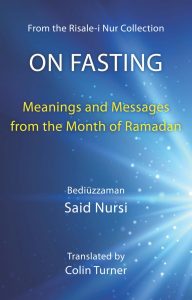
The Creator says, ‘Fasting is Mine’. And by fasting, here, we mean the wider practice of self-denial that is practised during Ramadan, when we deny our lower self – our nafs – the freedom to derive certain sensual pleasures wherever and whenever it desires. Fasting is loved by the Creator more than any other form of worship in Islam.
It is not difficult to understand why fasting is so precious to Him. Unlike the five-times-a-day prayer, the giving of charity and the pilgrimage to Mecca, fasting is an invisible act, a ‘passive’ worship, if you will. It is easy to make a show of your prayer, of your giving charity or of your pilgrimage to Mecca. This is because when we pray, or give zakat, or utter the shahada, or go to Hajj, we are actually doing something. And it is very easy to claim ownership over the things we do. But when we fast, when we fast, we are not actually doing anything at all. It is, for all intents and purposes, a ‘non-action’. And it is practically impossible to make a show of our fasting because it is invisible to everyone but Him. Fasting offers the least opportunity for pride and arrogance. Fasting, then, is for God alone, and in it we actually have no ‘active’ part. This is why He loves fasting more than any other expression of worship. This is why He says, ‘Fasting is Mine’. Fasting is unlike any other act of worship, in the same way that the Creator is unlike anything in existence.
Bediuzzaman Said Nursi’s treatise on Ramadan is presented here in its new English translation. Said Nursi’s main work – the Risale-i Nur, is currently being re-translated into English, with a focus on the communication of meaning rather than on strict, word-for-word equivalence, which often obscures what the author is trying to say and makes reading more of a task for the reader than a pleasure. We offer this as a Ramadan gift to all of those who wish to learn more about the wisdoms behind the Ramadan fast.
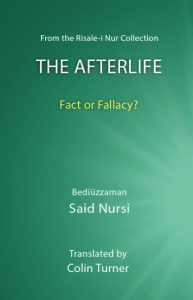
Written in the mid-1920s, Said Nursi’s Tenth Word, also known as the Treatise on Resurrection, appeared at a time when, throughout all of the educational establishments of the new Turkish Republic, the move to distance students from belief in God and the hereafter was gaining momentum. One of the ideas then being promoted was the rejection of the idea of bodily resurrection. The writing of the Tenth Word was in effect a reason-based response to that denial. Almost a hundred years have passed since this treatise first appeared, and while much has changed in the intervening century, atheism and naturalism are in many ways every bit as prevalent now, globally, as Nursi feared that they might become. Were he alive today, I tend to think that he would deem the Tenth Word every bit as necessary now as it was back in the 1920s, if not more so.
Nursi’s methodology in the Tenth Word is, like that in most of his works, heavily dependent on the Quran. The Quran appeals to human reason in its various attempts to demonstrate both the reality and the rationality of the hereafter, and the resurrection and judgment which precede it. The Quran insists that its readers reflect upon God’s many varied ‘signs’ before affirming the truths which they indicate. Indeed, nowhere is the idea of blind acceptance of these fundamental principles sanctioned or tolerated. Belief must have its source in the affirmation of what is, at base, logical and reasonable. Throughout the Tenth Word, Said Nursi brings to our attention many of what he claims are solid proofs of the existence of the resurrection, the ‘grand tribunal’ of Divine judgment, and the existence of heaven, hell and everlasting life. Of course, the Nursian ‘proof’ is more strong indication than proof in the usually accepted sense of the word, for after all, realities such as the hereafter are not rationally demonstrable: one cannot provide scientific evidence of the existence of the next world, and nor can one evince photographic evidence of heaven or hell. However, what Nursi does is to offer rationally and emotionally appealing arguments around this-worldly signs and indications of the next world which are always based in logic and never less than intellectually reasonable. In fact, his method is more or less the same method used by the Quran to convince its readers of God’s oneness. And that is to throw light on the countless signs (ayat) scattered through the universe in general, and in the very being of humankind in particular, which with overwhelming clarity provide inference to the best and most reasonable explanation. Nursi is in this sense a most loyal interpreter of the Quran, holding up a mirror to Divine revelation and replicating its approach in all of his discussions and arguments. To read Nursi, then, is to read a clear and faithful interpretation of the Quran which appeals not only to the intellect but to the heart, both of which must be fully satisfied before they are able to affirm the reality of the hereafter and attain a true and lasting belief in its existence.
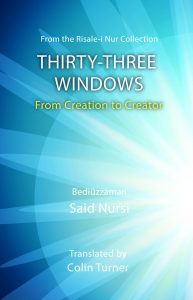
Said Nursi’s Thirty-Three Windows, also known as the Thirty-Third Word or the Thirty-Third Letter was written to provide a concise explanation of how the universe in general, as the macrocosm, and humankind in particular, as the microcosm, display and indicate the existence and unity of God, while at the same time demonstrating the functions of Divine lordship (rubūbiyya) and the ever- changing manifestations of the Divine attributes. As such it affords the reader a close-up view, through thirty-three ‘windows’, of how Said Nursi sees the cosmos as a vast ‘book of creation’ that demands to be read and interpreted.
Moreoever, it shows that the only way in which this ‘book of creation’ can be seen to truly make sense is if it is read and interpreted in the name of the One who has authored it.
However cliched it may sound, illness always has the potential to be a blessing. For like all forms of communication from our Creator, illness is telling us certain things in certain ways. It may be telling us to slow down and to live life less hectically. It may be telling us that we are not eating healthily, or sleeping enough, or getting the amount of exercise that we is needed to remain healthy. Depending on its seriousness, it may be telling us that a complete ‘life overhaul’ is necessary. But whatever it is telling us on the level of specifics, there is a general message that comes with all illness, and that message is, quite simply, that we are, at base, impotent beings who are at every instant dependent on God’s grace and loving attention for the continuation of our existence. For the weakness that we experience during illness is only a reflection of our existential weakness. Illness comes with the reminder that everything we are, and everything we have, depends on His love and generosity: who we are, and what we appear to possess, depends solely on His will. Illness helps us understand this by reducing us to a childhood state of utter neediness and dependence on others, for it is this state only that can help us reconsider whether we are living our lives with the recognition of our impotence or not. For we are impotent whether we are well or whether we are ill; it is just that it’s harder to realise this when everything in the garden is rosy, so to speak. Illness, therefore, can be a blessed wake-up call, halting us in our tracks in order to give us the time and situation necessary for stock-taking and worshipful reflection of our life situation and its attendant duties. Illness, seen as a blessing, inevitably turns out to be such. This treatise shows us a number of reasons why this is so.
The Short Words comprises the first ten chapters of the thirty-three-chapter work known as The Words, which in turn forms the first part of the Risale-i Nur (Epistles of Light) collection, a commentary on the Quran that totals in excess of six thousand pages. The Risale-i Nur was written in Turkish by one of the modern age’s most significant Muslim scholars, Bediuzzaman Said Nursi (1876-1960). Nursi wrote this monumental work in order to explain the truths and realities of belief, both to his fellow Muslims and to modern humankind in general. In Nursi’s view, we are in this modern age confronted by a profound crisis of meaning, and in the face of the assaults of materialist philosophies and ideologies, the question which must be prioritised over all others for Muslims is the saving and strengthening of belief. For it is only in belief in the Creator, the Source of all being, that humankind’s true happiness and progress, and the cure for the wounds caused by materialism and misguidance, are to be found. Nursi devoted a whole life of learning and scholarship to realising these aims. Bediuzzaman Said Nursi’s treatise The Short Words are presented here in its new English translation with a focus on the communication of meaning rather than on strict, word-for-word equivalence, which often obscures what the author is trying to say and makes reading more of a task for the reader than a pleasure. The Short Words are, as the title suggests, short, simple, reader-friendly pieces describing, through the use of comparisons, metaphors and analogies, the virtues of belief and worshipful action. The Short Words showcase Nursi’s own unique style of instruction through short, accessible parables on the relative merits and demerits of guidance and misguidance and belief and unbelief, pointing out how alien to human nature the rejection and denial of God really are, and showing how humankind’s true happiness and progress can be found only in recognition, acceptance and worship of the Maker of the universe, and in worshipful action on His account.